Showing posts with label Lab. Show all posts

Tuesday, 6 December 2011

Ticked off - and really happy!


As scientists our jobs involve a lot of project management: I myself at this moment am running three projects within one umbrella project, and this requires good organisation skills, good time management and note keeping.  Note keeping I would say is the most important, and although I am the first to admit I am not perfect: I have recorded notes in pencil instead of pen *gasp* - but only because I had lost my pen down the back of the bench - and I scribble and scrawl instead of, er, write; I do make an effort to get everything down of what I have done that day - what the outcome was and what I am going to do next.  I cannot describe how frustrating and sometimes how nerve-wracking it is, while you are setting up a complicated experiment - that may have to run its course overnight or over the weekend - for you to get distracted for one tiny second and forget what you have just done, or just added!!! At this point you have two choices: you can either throw it all away and start again - and waste materials (possibly some of which you have had to meticulously prepare yourself) and time and money, OR, you can continue, hoping that you have just done what you thought you had done right,

.......and spend the rest of the evening or your weekend biting your nails off.


SO ALL HAIL THE GREAT LAB BOOK! (Or laptop, note pad, ipad, whatever you prefer), the great keeper of reaction mixtures! - where every ticked off component is a swipe of  relief and assurance that it has been truly added and is contributing to your experiments success! (Or you'd hope so).

Yes, note keeping is important, and in this job it can be a very reassuring and pleasing to be ticked off all the time! 

Tuesday, 15 November 2011

PhD in burger flipping!! No, seriously...


As reported last night in A Brave New World with Stephen Hawkings and in Sky news today, science is taking a turn towards the culinary, with scientists looking to create the world's first lab-created burger! In answer to growing world hunger and to reduce the ecological impact of farming meat-yielding animals worldwide, Mark Post at the University of Maastricht is aiming to grow cultures of meat cells dervived from meat leftovers from slaughterhouses.  These cells at a certain point will then be seeded onto collagen fibres where they will grow to form strips of meat.  The muscle strands, like in nature, will be exercised by being stretched with the aid of velco strips to create bulk.  All the while the cells are nurtured and grown in growth medium rich with carbohydrates, amino acids and fatty acids.  When mature, the strips can be harvested and then, I guess, grilled! To make a fabulous burger! Hmm-mmm!

If an edible product can be produced from this technique, the implications are huge and can change the way we view meat and food forever.  For example, we can stop feeling guilty  that animals are being slaughtered en masse for our consumption and we will all be obsessed with which university our meat was produced from (Those with a 5-star RAE rating will of course feature in Michelin star restaurants).  However, Post warns that the resulting produce will not be cheap.  He reckons that the resulting burger will cost a whopper £200,000! This cost is justified, what with the great technical skill, the time and labour undertaken to grow and maintain the meat cells.

 One beef burger and one lamb burger in the making...

'Hell yeah!' every cell culture scientist will shout!  For behind the glitzy, dizzying thoughts of solving world hunger and saving all those cute fluffy farm animals (not to mention having a permanent work contract) are the tears and the pure frustration that every cell culture scientist will have experienced in just growing and maintaining those damn cells, nevermind processing them for human consumption!  Mammalian cell culture is a notoriously delicate process: everything from the nutrients in the media to the temperature of the incubator and the level of carbon dioxide present has to be perfect; otherwise, when you look down the microscope all you will see are dead cells floating on by.  There is also the problem of infection, as the cells have no immunity and cannot be made immune: infections from mycoplasma and yeasts, all present in the air or carried on in by the researcher on their skin or clothes, can cause massive cell death of every sample present in that lab.  The infective agent can be difficult to trace and eradicate, and I have seen some researcher friends sigh and shake their heads as their work is being delayed for months as they try to solve this problem.  So sorry sir, but dinner is delayed.  Would you like some lab grown fries while you wait...?


Oh, us poor plebby scientists are donkeys enough - what with be underpaid, unappreciated and unrecognised.  To end up being burger growers and flipper PhD is the ultimate low - and even then the job doesn't get easier!  

An 8oz myco-burger with fries, coming up!  


Source: A Brave New World with Stephen Hawkings


Sunday, 13 November 2011

So it is true, you CAN die of a broken heart!


A phrase normally associated with romantics, poetry and the arts, it can now be revealed that one can actually be heavily - and fatally - affected by one's feelings.  The "nocebo" effect or reaction (Latin meaning "I will harm"), is a medical term used to describe harmful, unpleasant and unwanted effects manifesting in a patient upon receiving a dummy drug.  As discussed by Penny Sarchet in her award winning essay for the Wellcome Trust science writing prize, this is the opposite to the "placebo" effect, whereby upon receiving the fake sugar pill, the patient actually feels better.  According to Sarchet's research these were evident during pharmaceutical trials in the eighties, where heart patients were more likely to suffer side effects from blood-thinning medicines if they had been told of any potential side effects the drugs may have.  The nocebo effect is also contagious; psychological-bourne illnesses have been reported worldwide effecting en-masse, "usually affecting close communities and spreading most rapidly to female individuals who have seen someone else suffering from the condition."

Very little is known about how the nocebo effect works.  A study carried out earlier this year by a group led by Professor Irene Tracey (Oxford) found that when volunteers were subjected to noecbo pain, brain activity corresponding to actual, neurological pain registered on an MRI scanner.  One of the neurochemicals responsible for converting this expectation of pain into a real sensation has been identified by Fabrizio Benedetti (Turin) and colleagues as cholecystokinin, a neuropeptide that acts on CCK receptors that are found throughout the human nervous system.  Cholecystokinin acts on the gastrointestinal system is responsible for bringing about the digestion of fat and protein.  However, it is also causes anxiety and nausea and is administered to test subjects in order to cause artifical panic attacks for research and the development of anti-anxiety drugs.

From these findings Parchet highlights the importance of the doctor-patient relationship.  Since the life and wellbeing of the patient is in the hands of the doctor, trust and confidence in his or her methods are vital.  In light of these findings, if the doctor lacks empathy and social skill or fails to project self confidence, then there is the danger that the patient, fearing the worst, will not respond well to any treatment given to them, as actually verified by Irene Tracey's team.

I would like to expand on that a little.  While not being a researcher in this subject, it is clear that anxiety is rife this modern age and doesn't just exist in medical terms.  It is there as soon as we open our eyes in the morning; it is there as we make our way to work and school; it is there during our entire day and it is there waiting for us when we get home.  From these findings I would say we need to examine our relationships with everyone - if we were all kinder, more tactful and showed greater empathy for eachother, physically, mentally and emtionally we might all be better off. 

Less stress, less anxiety and less heartache.


Wednesday, 10 August 2011

How scientists view each other

It was brought to my attention (by another post doc) that there is a very interesting, insightful and visual of how people in science see each other.  Check this out!


Image taken from DrugMonkey.  Please click to see a bigger image.


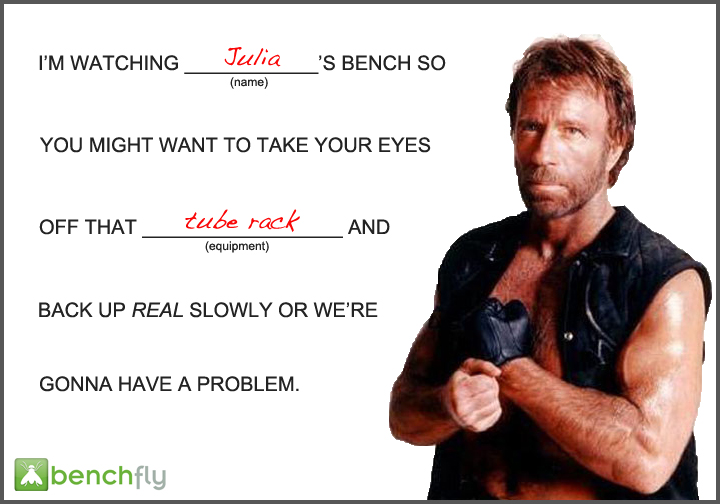
I especially like the one where technicians see themselves as Chuck Norris - strolling in and kicking practical science ass - every time and every day! Btw, Chuck can also defend your bench from nifty fingers:


Also check out 'Definitions' to see the "power" status of each member of the lab:


DEFINITIONS 
By Lawrence and Gail Bloom 
Appeared in J.I.R., December 1974 


CHAIRMAN OF DEPARTMENT 

Leaps tall buildings at a single bound 

Is more powerful than a locomotive 

Is faster than a speeding bullet 
Walks on water 
Gives policy to God 


PROFESSOR 

Leaps short buildings at a single bound 

Is more powerful than a switch engine 

Is just as fast as a speeding bullet 
Walks on water if the sea is calm 
Talks with God 


ASSOCIATE PROFESSOR 

Leaps short buildings with a running start 

Is almost as powerful as a switch engine 

Is faster than a speeding BB 
Walks on water in an indoor swimming pool 
Talks with God if a special request is approved 


ASSISTANT PROFESSOR 

Barely clears a quonset hut 

Loses tug of war with locomotive 

Can fire a speeding bullet 
Swims well 
Is occasionally addressed by God 


INSTRUCTOR 

Makes high marks on wall when trying to leap buildings 

Is run over by locomotive 

Can sometimes handle gun without inflicting self-injury 
Dog paddles 
Talks to animals 


RESEARCH ASSOCIATE 

Runs into buildings 
Recognizes locomotive 2 out of 3 times 
Is not issued ammunition 
Can stay afloat with life jacket 
Talks to walls 


GRADUATE STUDENT 

Falls over doorsteps when trying to enter building 
Says, “Look at the Choo-Choo.” 
Wets himself with water pistol 
Plays in mud puddles 
Mumbles to himself 


TECHNICIAN 

Lifts buildings and walks under them 
Kicks locomotives off the track 
Catches bullets in his teeth and eats them 
Freezes water with a single glance 
Is God …


The eye of Mordor is back tomorrow.  I had better get my get hooves back on the ground and start hauling my load ;-)

'Til then!

Tuesday, 9 August 2011

Back up and running (kind of)


Apologies for my absence, I have been busy.  Things have been a bit heavy at work but they seem to be getting a little bit better.  For several months I have been going through what many scientists go through: frustration, loss in confidence and self doubt.  I had this towards the end of my PhD too, and it is a real killer.  Everything grinds to a halt or is super duper slow, and time and everything else seems to be against you.

It was in these couple of months though that I discovered this blog on Bench Fly.  It has this wonderful section on science and life that contains some insightful and amusing advice on how one's outlook on experiments, life and the like should be.  I am sure there are others like it out there and posts on science forums.

It goes to show that communication with those who have been through it all and having a life outside the lab is essential for dealing with the issues in this line of work.  If you are finding yourself also in a similar situation and everything is getting you down, please talk to someone or join a science forum or read blogs such as the one on Bench Fly.

Most importantly keep healthy and keep smiling.

Thanks for reading x

See: Bench Fly   


Friday, 17 June 2011

Daily challenges in the lab

Ah, such is the life of a scientist, where nothing, nothing is straightforward!  Science never sleeps; it is like a never-ending unfolding story, with as many twists and turns as you like and then some.  Recently, yours truly has been going through a rough patch in the lab of late: a ligation experiment that would allow for some wonderful and intriguing discoveries isn't working, the mutant yeast strains I have generated are not what they seem.  I am repeating some stages in my experiment that I did three months ago.  In the meantime, other experiments I really want to do to get things moving are on hold while I try to find out what I am actually working with.


What the hell are you?! Answer me, damn mutant!!

 If molecular biology was a video game and there were bosses - gigantic monsterous enemies you must battle to get to the next stage (not your supervisor, although opinions may differ on this point) - then ligation would definetly be one big bad boss!  The idea of cutting up pieces of DNA with restriction enzymes and sticking them together with DNA ligase sounds simple enough, but there is a lot of fine tuning involved.  The ratio of vector DNA versus insert DNA is important, get this wrong and it might not work.  The ATP in the ligase buffer needs to be in good condition as this is needed by the enzyme to function.  The temperature needs to be right, the salt and pH conditions need to be right, your mood needs to be right, the funny dance that you do with the pirouette at the end to ward off bad luck...right! 

Giant, evil-looking ligation boss: 1 million points ; tiny, suffering scientist: none


But for now, something is amiss and I need to find out why so I can move on.  One of the frustrating things about science is time: it takes a good few hours to digest the DNA, half an hour to clean it up, half an hour to prepare it for ligation and then another hour for the actual reaction.  It can be so frustrating to find out after all that time it hasn't worked and you have used up loads of enzyme, tons of DNA and it is late in the day so there is little you can do about it - apart from huff and puff all the way home.

So, good people of the blogosphere, if there are any scientists out there who can impart a little advice on how to make ligations work, please feel free to sprinkle me some crumbs of wisdom.  Otherwise just wish me luck - I sure could do with some!   

Thursday, 26 May 2011

Queen Victoria on film!!!

So there I was, measuring the intensity of the radiation emitting from my southern blot. The click, click, click-click-click sounds from the geiger counter sounded a bit too frequent (meaning that the blot is not as clean as it should be and needs extra washing to get rid of the residue isotope) but that day I was impatient (and a bit desperate!) to see something, anything on my blot. So I carefully dried it on a piece of tissue, wrapped it in cling film, stuck it down in the casette and exposed it to film overnight.

I had expected to see bands on the film of my DNA with some residue blobs here and there. Imagine the shock when I saw this! :


Over-exposure!! At its finest!!!

But look at the outline in the centre. Does it look familiar?


Queen Victoria! On MY film! How cool is that???

Monday, 16 May 2011

We are human after all

While trawling the internet, I found this story: 'American biologist trapped on UK beach phones 911... and is rescued after operators in Washington put her through to British police.' Not the finest moment for anyone and especially for one whose profession portrays them to be intelligent and knowledgeable. However, we must remember a job title is just a job title and a qualification is just a qualification. Underneath it all there is a person, who can make silly mistakes just like everyone else. We are human after all.

Wednesday, 11 May 2011

Lab frustrations!!!

From practical grievances to writing up and publishing the damn stuff, these links say it all!


Caught in a bad project!


Herr Professor is not amused...

All this leads to everyone submitting their work to this prestigious journal:


Where all submissions, regardless of the quality, will be... rejected! Here are the reasons for why this is a good thing as according to the journal:

1. You can send your manuscript here without suffering waves of anxiety regarding the eventual fate of your submission. You know with 100% certainty that it will not be accepted for publication.

2. There are no page-fees.

3. You may claim to have submitted to the most prestigious journal (judged by acceptance rate).

4. The JofUR is one-of-a-kind. Merely submitting work to it may be considered a badge of honor.

5. You retain complete rights to your work, and are free to resubmit to other journals even before our review process is complete.

6. Decisions are often (though not always) rendered within hours of submission.


Have a nice day and keep smiling!

Check out: Journal of Universal Rejection

Wednesday, 27 April 2011

RNase Evil

For those scientists working with RNA you will feel my pain: so I got in early today to set up an RNA glyoxal gel:


I loaded my RNA samples, ran the gel for 5 hours and this was the result:


Arrraagh!!!!!!

It appears that I have RNase contamination in my gel! This is an enzyme found in abundance on skin (and in saliva and tears) that specifically destroy RNA, hence the horrible smeary bands you see. RNase can be found on almost every surface in physical contact and is hell to get rid of. For a better description - and for how I and many others who work with RNA feel about this enzyme - check out this page or just take me at my word - Evil! Evil! Evil!

Imagine you are the RNA, and those are RNases...coming after you...


RNA stands for ribonucleic acid and is one of three types of macromolecule (the other two being DNA and protein) that are essential for all forms of life. RNA is very similar to DNA in that it is made up of a string of nucleotides, the sequence of which allows RNA to encode genetic information, similar and as derived from DNA. However, unlike DNA, different types of RNA molecule exist, and are involved in many enzymatic processes within the living cell: that as well as encoding and passing on the information to synthesise proteins, RNA can direct and regulate gene expression, function in protein synthesis and sense and respond to cellular signals.


An x-ray structure of transfer RNA - a type of RNA that is involved in recruiting and linking amino acids together in the process of protein synethesis. Image by Yikrazuul.


Yet despite being so deeply involved in many vital biological processes RNA is very unstable. This is not surprising since a lot of these processes are rapidly occurring and are responsive to internal and external factors. RNA molecules generated now may not appropriate for what may occur at a later stage; their prolonged presence may even be deterimental to the cell in that specific catalytic processes may be overexpressed or suppressed; certain functions may be deregulated. One can say instead of being cogs in a well oiled machine they are now like spanners in the works.

So, yes, it is good that RNA is easily degradable and RNase is in abundance to do it - just not when one is trying to isolate and study it!!! So it will be take-two tomorrow: I am going to encase my hands in chain-mail gloves and treat all my equipment and my bench with a flame thrower. Hasta la vista RNase...


Kidding!!!


Wish me luck!

Monday, 4 April 2011

Fat cats and dead rats

Image by brokinhrt2

Today I went to the first of a two day course titled 'Career Management for Researchers - Broadening Horizons'. The aim of the course is to recognise that with so few academic positions available nationwide, it is necessary for university staff on contract employment (such as yours truly) to think about the transferrable skills we have in order to find permanent employment elsewhere.

The declining number of positions is in line with the cuts the UK government has announced for university funding: according to The Guardian £940m will be cut from the 2012 budget for teaching, research and buildings. This announcement is a massive blow for science departments everywhere who are already struggling to obtain funding. The regulations to date, set by various research councils, state that successful research proposals should have a social or/and economical impact. This has put a huge pressure on laboratories, such as the ones I have worked for, that carry out what I call 'pure' research; where a subject is being studied solely for the expansion of knowledge and discovery. The findings of these projects are by no means "useless" or a "waste of money". It is the probing nature of this type of research that leads to the better understanding of the complexity of life, in the standpoint of physics, chemistry and biology. I believe that forced cessation of such projects will lead to the decline of useful knowledge that could lead to the discovery and development of new medicines and technology; the vital component of work that, ironically, would have a social and economical impact.

The announced cuts for 2012 means that many research groups will be scaling down and tightening belts than ever before. Many highly qualified and talented individuals who have trained long and hard and have made many personal sacrifices for the sake of their careers will be unceremoniously made redundant. This is insult to injury since professionals in other fields of work have excellent job security, decent pay and benefits and, most importantly, are recognised and appreciated.

Tonight, as I wring my hands at the prospect of being a job seeker that is too old and too over-qualified for most types of work, I see that our Vice-Chancellors are not feeling as worried. Dispatches on Channel 4 has reported that while universities are facing cuts, students (their parents) will be hit with massive tuition debts and academics and researchers will be out of a job, university Vice-Chancellors are livin da vida loca with salaries up and over a quarter of a million pounds. In addition, they reside in luxurious accomodation and have ski chalets, chauffeured driven cars, membership of exclusive clubs - all taken care of by the "cash-strapped" universities. My hands are wringing even harder.

Memories of a quip from an ex-colleague enters my mind: "it is time to find a real job". This epitomises the life of a present-day academic science researcher. Far from the romantic ideal that universities are a haven for those who wish to make a living through knowledge and discovery, the reality of the situation now is that through commercialisation the fat cats are getting fatter and the lab rats are facing certain death.

See: Dispatches

Sunday, 3 April 2011

No thank you, GM cows...


It was reported late yesterday evening that researchers at the State Key Laboratories for AgroBiotechnology in China's Agricultural University has successfully introduced human genes into a herd of cows in order for them to produce milk similar to that of human breast milk (see The Telegraph). This latest advancement in GM research is to enhance the presence of key nutrients, missing or found as a low level in cows milk, that are vital to a baby's health and development. At present, three types of genes have been incorporated by microinjection of the modified genetic material into bovine somatic ('body') cells. The nuclei of these cells were then transferred into donor cells, from which transgenic bovine embryos were created and the resulting cows could express lactoferrin, lysozyme and Alpha-lactalbumin in their milk. The observed high yields from these "mammary bioreactors" is seen as a positive step towards the industrial scale production of GM milk.


The process of creating clones by somatic nuclear transfer (taken from de: Quelle: Zeichner: Schorschski / Dr. Jürgen Groth)


However, these findings will also alarm and outrage those who are against the use of GM for food production. There is the obvious safety issue of consuming products that have been unnaturally enhanced and of which the short and long-term effects of consumption are unknown. There is also the concern for the welfare of the animal, since the previously created Dolly the Sheep - although deemed a healthy clone - had an unusually short life-span and suffered health problems.

In the UK, the concept of GM food has had so much bad press that supermarkets go to great lengths to stress that the food they sell are GM free. Furthermore, the use of breast milk for commercial purposes has already caused quite a stir - the recent offering of "Baby Gaga" - breast milk ice cream made from donations of a lactating mother - has invoked mixed feelings ranging from curiosity to disgust (see BBC News).

The question that weighs heavy on my mind is this - why is it that these cows are required when a human mother is quite perfectly able to feed her own child? For argument's sake, there are those mothers who are unable to feed their baby, such as those with a medical condition or are taking/addicted to substances that could risk harm to the baby. However, cannot a human lactating mother donate milk for this purpose? In the case of the ice cream, there were a number of mothers who expressed an interest in offering their milk for financial gain. Cannot healthcare companies/the government pay these ladies to help fellow mothers in need?

In the commercial sense I suspect that when the time comes, the marketing ploy to convince western mothers to use GM milk will be largely based on cosmetics. The perceived unattractiveness of "saggy boobs" as a result of 6 or so months of breastfeeding per baby could be totally avoided by the use of an alternative and equally nutritious source. If that is the case, vanity has reached new heights.

In conclusion, my personal opinion is this - Mothers and women of the UK should unite, burn those bras and chain themselves to the gates of parliament in protest. Not only is breastfeeding a way to feed a child it is also crucial for the bonding between mother and baby; the first step towards building a relationship that is positive, unique and special. Scientific commercialism, vanity and social pressure should not be allowed to undermine its importance. No thank you, GM cows.

Story: The Telegraph

Also see:

PloS One